Journal
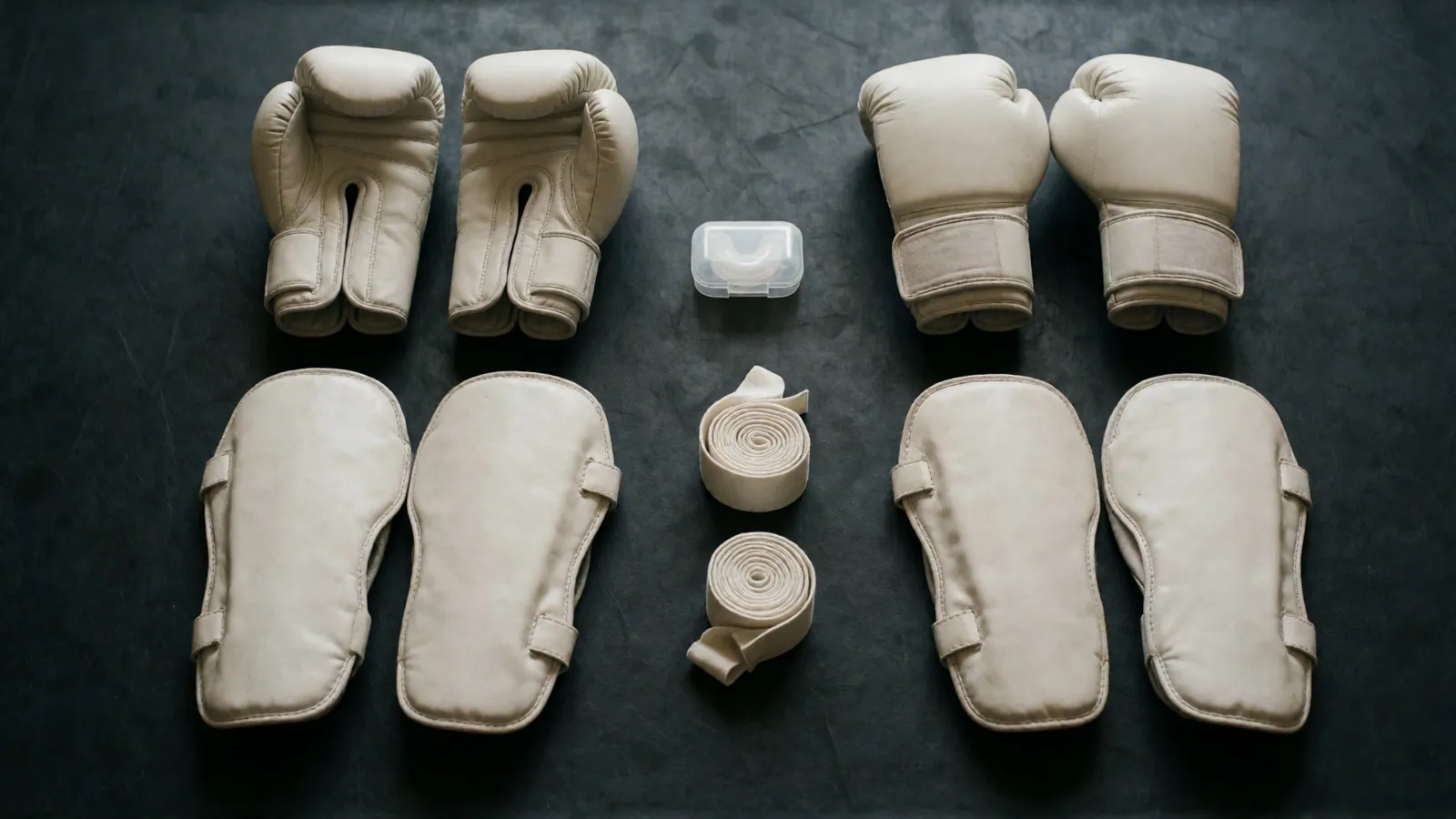
Gloves, wraps and shin guards: a beginner's guide
What size of glove, how long a hand wrap, what shin guards to look for, and what to borrow from the desk before you buy anything.
AI-generated illustration. Not a real school.
Striking classes need a little gear, and the first visit to a shop or a website full of it is confusing: weights in ounces, wraps of different lengths, guards with straps and guards with sleeves. This guide explains what each piece is for and how to choose it. It names no maker and quotes no price, because neither is the point; fit and purpose are.
Borrow before you buy
Not for a first class. After a few, jiu-jitsu needs a plain uniform and Muay Thai your own gloves and hand wraps; the gear guide in the journal has sizes.
Borrowed gloves are fine for a first few classes. Buy your own once you have decided to carry on, partly for fit and partly because gloves soak up the sweat of whoever wore them last. Hand wraps are worth buying from the start: they are inexpensive, personal, and nobody wants to borrow somebody else's.
Gloves
Gloves are sized by weight in ounces, and most of that weight is padding. A lighter glove is quicker and lets you feel the bag; a heavier one protects your hand and, in sparring, your partner's face.
For bag and pad work most adults are comfortable in a middle weight. For sparring the usual rule is a pair of sixteen-ounce gloves, and many coaches ask for nothing lighter whatever your size. If you will buy only one pair, buy the pair you would be allowed to spar in: heavier gloves on a bag are slower but never wrong, and lighter ones in sparring are.
Fit matters more than anything printed on the glove. With your hand wrapped, your fingers should reach the end of the glove without being cramped, your fist should close fully, and the wrist strap should hold the cuff snug without cutting in. A strap you can close yourself, with the other glove on, is easier than laces.
Hand wraps
A hand wrap is a long strip of cloth wound around the wrist, across the back of the hand and between the knuckles. It holds the small bones of the hand together and keeps the wrist straight when a punch lands, which a glove alone does not do. Wraps go on before the gloves, for every striking class.
Buy the long adult length: a short wrap runs out before it has covered the wrist and the knuckles both. Stretchy wraps mold to the hand and are easier for a beginner to put on well; flat cotton ones give firmer support once you know how. Either way, ask the instructor to show you how to wrap in your first class, and practice it at home until it is quick.
Shin guards
Shin guards cover the shin and the top of the foot, and are worn for partner work and sparring in Muay Thai, where shins meet shins and elbows. Nobody needs them for bag rounds.
Choose by the length of your shin, not your shoe size: the guard should reach from just below the knee to the top of the foot without gaps when you bend the ankle. A sleeve style stays put and is quick to pull on; a strap style adjusts more and suits a shin between sizes. Try a few kicks in them before you decide. A guard that spins round when you kick is the wrong size.
A mouthguard
A mouthguard is worn for every sparring round, striking or grappling. The common kind is softened in hot water and bitten into so it takes the shape of your teeth; follow the packet's instructions exactly, and do it twice if the first fit is loose. A dentist can make one that fits better still, and anybody with braces should ask about one first.
Keep it in a vented case, rinse it after every use, and replace it when it is chewed or no longer clicks into place.
Sparring, when it comes
By invitation, after three months or more, a readiness check and with full gear; eighteen and over. The coach will say what full gear means for that class well before anybody is invited, so there is no need to buy anything for sparring in your first months.
Looking after it
- Wash hand wraps after every class and hang them to dry fully before rolling them up.
- Open gloves and let them air after every class, out of the bag; a glove that smells is a glove that has not dried.
- Wipe shin guards and gloves down with a damp cloth once a week.
- Never leave gear zipped in a bag overnight.
- Write your name inside everything: in a changing room, every pair of black gloves looks the same.
Further
What each class asks you to wear and bring is on what to wear and bring, and the rules every sparring pair keeps are on the sparring rules. Nothing is paid on this website. Memberships, courses, drop-ins and private lessons are paid at the desk.
Try one class first
Book your trial class, free once a year per person with no card and nothing to cancel afterwards, into a real class on the timetable. For a child's class or a course, ask for a place, and if it is full you join its waiting list in order.