Journal
Your first jiu-jitsu class: what happens and what to wear
The warm-up, the first technique, the first gentle round, the soreness the next day, and the three things to tell the instructor before you start.
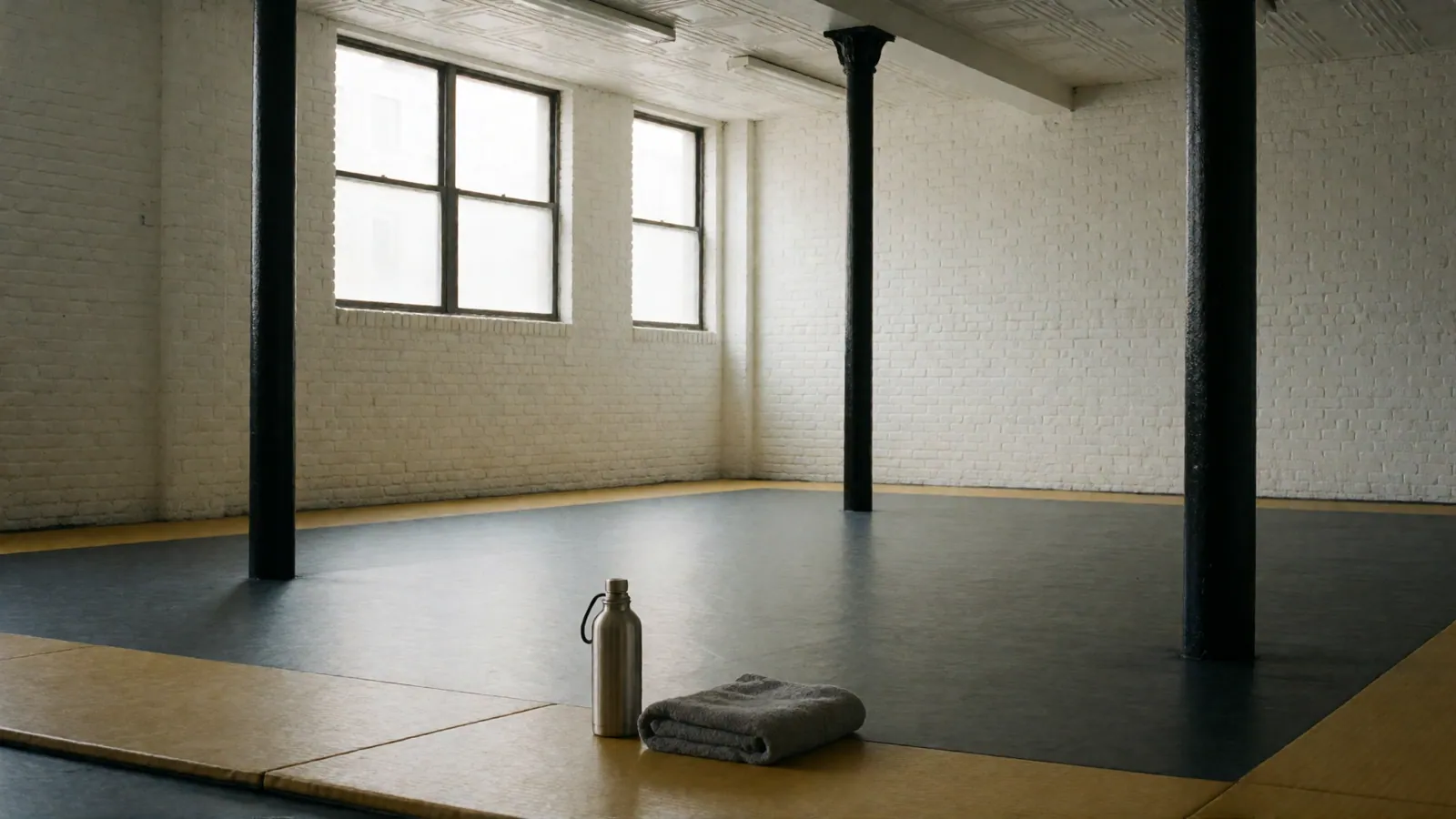
AI-generated illustration. Not a real school.
Most people arrive at a first jiu-jitsu class a little nervous, and most of the nerves are about not knowing what will happen. So here it is, in order: what to wear, what to tell the instructor, what the hour is made of, and how you will feel the next morning.
What to wear and bring
A T-shirt and shorts or leggings without zips or pockets, and a bottle of water. Shoes stay off the mat. For a striking class the desk lends gloves.
Gi classes need a plain jiu-jitsu uniform after your first few classes; no-gi needs shorts and a fitted top. Nobody expects one at a first class. Cut your nails short the night before; it is the first thing anybody on a grappling mat notices.
Three things to tell the instructor
Any injury or health matter
A sore back, a knee that clicks, a shoulder that came out once, something your doctor has said. You can write it on the participation form, but say it out loud too, so the instructor can tell you what to skip.
Whatever you have done before
Wrestling at school, judo as a child, a few months somewhere else, or nothing at all. It decides who you are paired with and how much is explained.
Anything you would rather not do today
Being underneath somebody can be uncomfortable at first, and some people dislike having their neck or head held. Say so. It is an ordinary thing to hear.
The warm-up
A class starts with a warm-up of movement that looks odd until you know what it is for: shrimping along the mat on your side, rolling forward and backward over a shoulder, getting up from the floor without using your hands. Each one is a piece of a technique, done alone first. Do them at your own pace, and copy the person in front of you.
The first technique
The first six months of jiu-jitsu in the gi: one position or escape a week, drilled slowly, then gentle positional rounds.
The instructor shows one position and one thing to do from it, slowly, two or three times, then pairs everybody up. You will do it on a partner and have it done to you, many times over, while the instructor walks round correcting grips and elbows. Expect to feel clumsy. Everybody does, and the repetition is the point.
The first round
Fundamentals classes never put a beginner into hard sparring.
Toward the end of the class there is usually a short round from a set position: one partner tries to hold, the other tries to escape, and then you swap. It is gentle, and your partner will have been chosen for being patient.
Sparring rounds are optional and you can tap, or stop, at any moment. You can also simply say stop. Tapping is not losing; it is how everybody keeps training the next day.
The next day
You will probably be sore in places you did not know you had: the forearms from gripping, the neck, the sides of the ribs, the hips. That is ordinary after a first class and fades within a few days. Drink water, and come back when the soreness has gone rather than waiting for it to stop happening; it stops on its own after a few weeks.
Mat burn on the feet or the knees is common too. Keep it clean and covered, and tell the instructor about anything on your skin that does not look like a scrape.
Afterward
Choose a class
Any class on the timetable that keeps trial places: a fundamentals class is the easiest start for adults, and a child's first class is in their own age group.
Book it here
Book it into a real class on the timetable, up to three weeks ahead and no later than three hours before it starts. Each class keeps a few places for newcomers, so a trial never makes a class too full.
Arrive fifteen minutes early
Sign the participation form at the desk (a parent signs for anybody under 18), and change; shoes stay off the mat.
The class
The instructor pairs you with somebody patient and tells you what to skip. Nobody new does hard sparring.
Afterwards, nothing
If you'd like to carry on, a month is signed at the desk. If not, there is nothing to cancel.
One free class, once a year per person, no card. Book a trial class: Jiu-Jitsu Fundamentals, or read what to wear and bring and jiu-jitsu or Muay Thai first.
Try one class first
Book your trial class, free once a year per person with no card and nothing to cancel afterwards, into a real class on the timetable. For a child's class or a course, ask for a place, and if it is full you join its waiting list in order.